



Immersive simulator
Explore every level of leadership in three dimensions
Travel from the purpose of leadership down through its three domains, nine dimensions, 35 competencies and 323 observable behaviours, in one three-dimensional space.
Opens full screen in a new tab. Press Esc or the cross to leave.
Explore the Framework
Find the behaviours that show great leadership
Every level of the Framework, on one page. Open a dimension to see its competencies, and a competency to see the observable behaviours that show it. Search to find any behaviour straight away.
- 3 Domainswhat leaders are, know and do
- 9 Dimensionshow each domain shows
- 35 Competenciesthe capabilities within them
- 323 Observable behaviourswhat you can see and assess
- 1,000+ Sourcesof research, evidence and practice behind it
Domain 1 of 3 · What leaders are
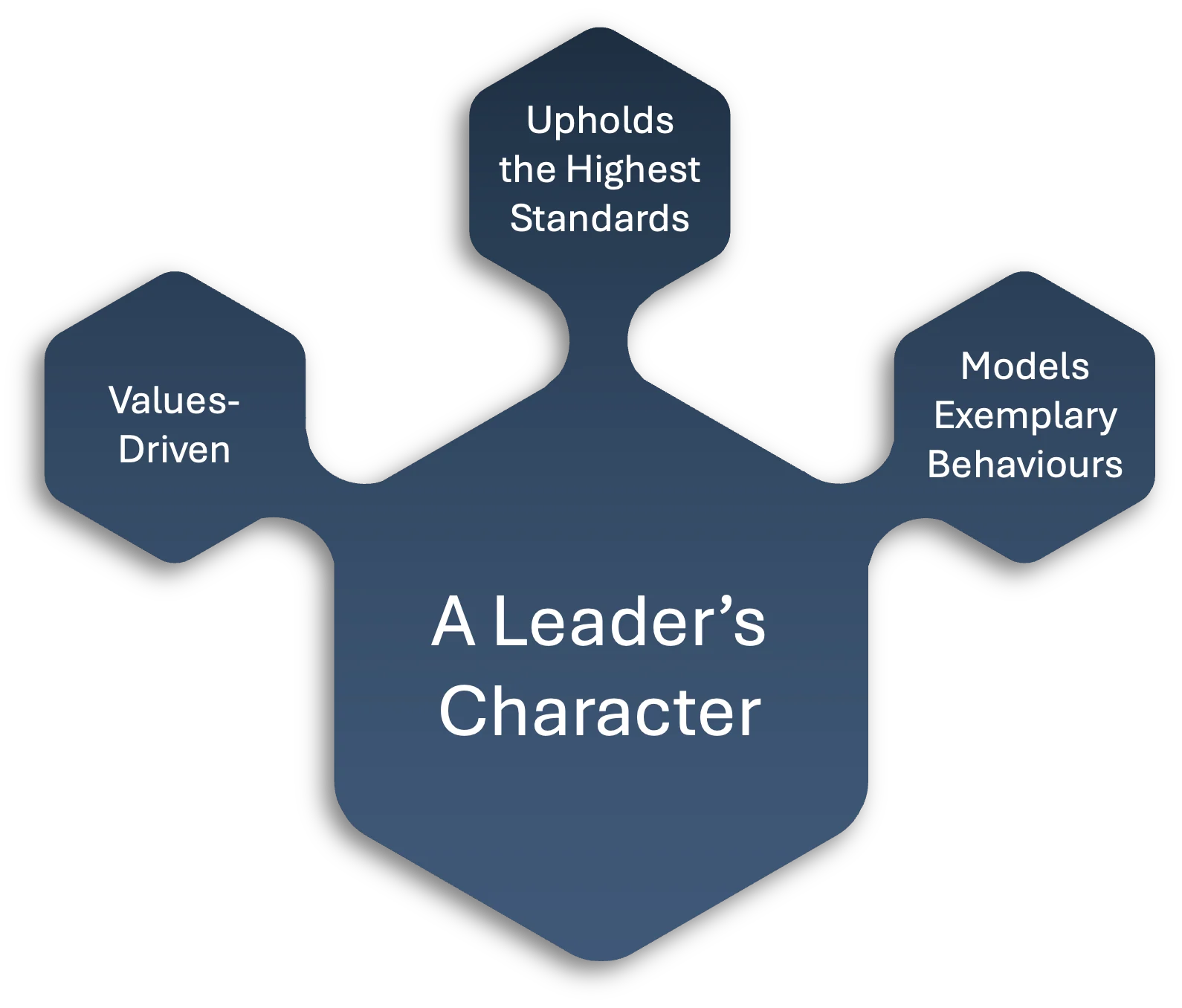
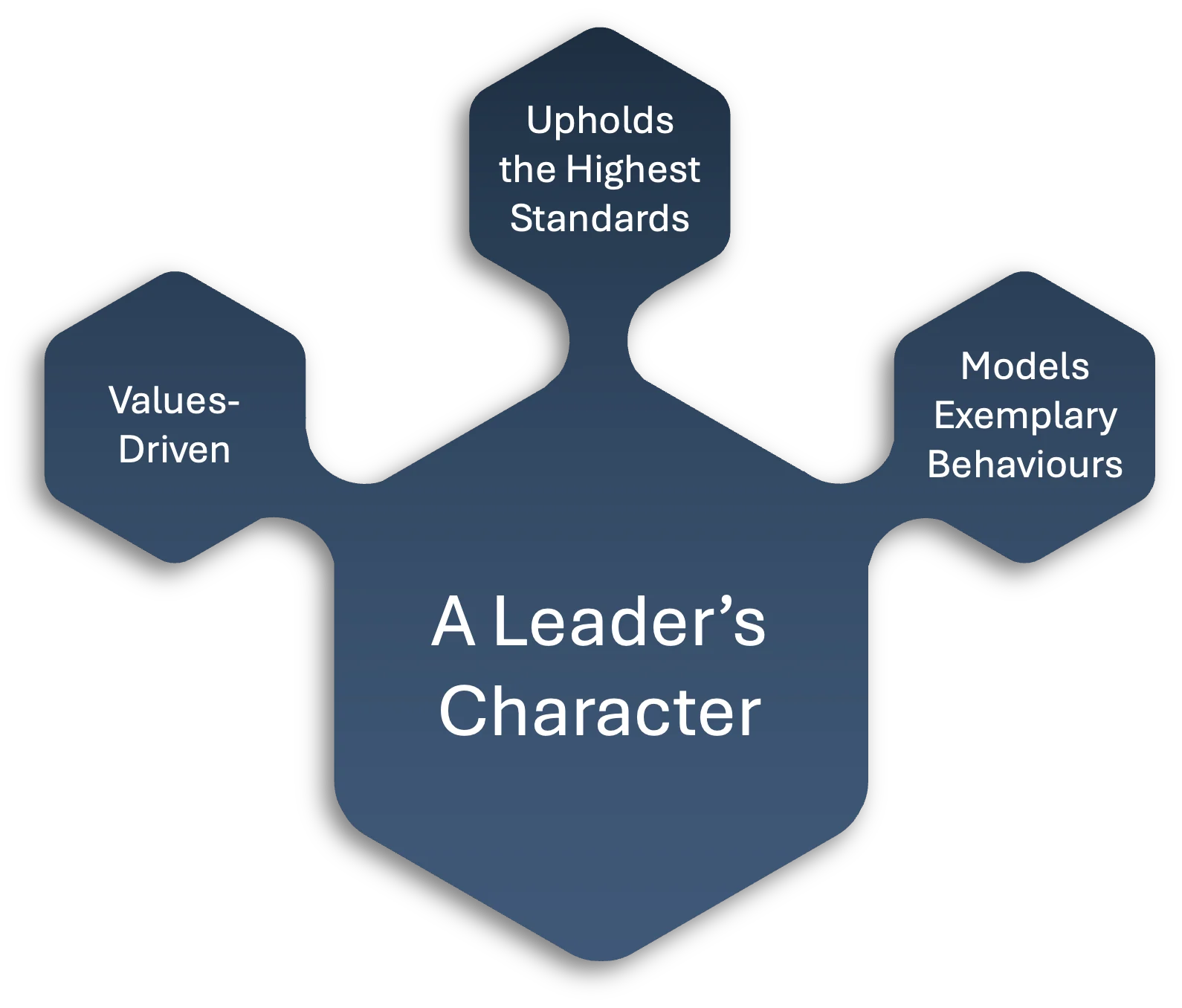
A Leader’s Character
3 dimensions13 competencies95 observable behaviours
Character is the foundation of leadership, shaping not only how leaders think, decide, and act, but also how they are perceived and trusted by others.
A leader’s character is expressed through three interdependent dimensions: being values-driven, which provides the inner moral compass directing choices; upholding the highest standards, which safeguards legitimacy and credibility by defining the non-negotiable expectations of leadership; and modelling exemplary behaviours, which make a leader’s character visible in action, providing a model for others to follow.
Together, these dimensions form a coherent and enduring foundation for leadership, ensuring actions remain principled under pressure, consistent through uncertainty, and worthy of the trust and followership upon which effective leadership depends.
“Character makes trust possible, and trust is the foundation of leadership”
John C. Maxwell
Values-DrivenLeaders are values-driven
Leaders are guided by values forming the moral basis of their authentic leadership approach. These values anchor beliefs, choices, and aspirations in ethically virtuous principles, shaping decisions and behaviours even under pressure or in uncertainty. Values-based leadership provides consistency of character, fostering social legitimacy and trust in others. Together, these values nurture the wisdom through which leaders discern the right course of action, exercise sound judgement, and serve a purpose greater than themselves.
Leaders demonstrate this through embodying the values-based competencies of:
Moral CourageLeaders demonstrate resolve, acting justly and with moral and ethical alignment, free from improper influence, despite risk of personal consequence.8 observable behaviours
- Exercises sound moral judgement and chooses ethically grounded actions
- Makes difficult and principled decisions, even when unpopular
- Resists unethical pressure, temptations, or rationalisation when facing moral dilemmas
- Appropriately challenges the immoral, unethical, or unjust behaviour of others
- Amplifies the voices of others who face injustice or unfair treatment
- Challenges practices and systems perpetuating injustice or inequity
- Acts despite personal fear when ethical action carries personal risk
- Encourages and enables moral courage in others through support and example
IntegrityLeaders demonstrate honesty and consistency, aligning ethical judgement and words with conduct and actions, even under pressure.8 observable behaviours
- Deals truthfully and honestly in all interactions
- Does what is right, even when no one is watching
- Ensures own actions are consistent with the same expectations set for others
- Honours commitments and follows through on promises made to others
- Communicates decisions openly, explaining rationale with clarity and transparency
- Aligns personal conduct with organisational values and ethical standards
- Upholds personal integrity when faced with competing interests
- Reinforces a culture of honesty and integrity, through clear expectations and personal example
Respect for OthersLeaders demonstrate regard for others’ dignity, rights, and perspectives through fair, inclusive, and respectful conduct.8 observable behaviours
- Treats others with professional respect and courtesy
- Acts reasonably and judiciously, assuming good intent in others
- Applies fairness, impartiality, and transparency when making decisions affecting others
- Ensures equitable access to development, opportunity, and advancement
- Promotes voice, participation, and belonging across individuals and groups
- Values individuality and diversity of perspectives, backgrounds, and experiences
- Addresses behaviours that belittle, dismiss, marginalise, disrespect, or undermine others
- Cultivates inclusive and respectful conduct within their sphere of influence
LoyaltyLeaders commit to people and purpose, applying principled judgement when loyalties conflict with integrity, standards, or shared goals.7 observable behaviours
- Displays consistent commitment to the organisation’s purpose, values, and people
- Advocates for colleagues’ interests and wellbeing, even in their absence
- Supports colleagues’ ideas and contributions with measured appropriateness in wider forums
- Offers constructive and responsible challenge to colleagues and leaders when necessary
- Balances loyalty to individuals with duty to organisational objectives and outcomes
- Reconciles competing loyalties by prioritising the collective purpose
- Rejects blind or misguided loyalty that compromises integrity and standards
ServiceLeaders demonstrate dedication to a purpose beyond themselves, stewarding people, resources, and reputation for long-term collective benefit.8 observable behaviours
- Prioritises collective purpose above personal status, benefit, convenience, or short-term self-interest
- Stewards resources responsibly, balancing effectiveness with restraint and long-term sustainability
- Protects organisational interests and integrity against competing or misaligned agendas
- Enhances organisational reputation through ethical and values-driven conduct in external settings
- Promotes sustainable practices that preserve social, environmental, and institutional resources
- Invests in others’ development to strengthen long-term organisational capacity and resilience
- Supports initiatives that contribute positively to the wider community and society
- Privileges long-term public or organisational benefit over short-term gain or expediency
Humanity and CompassionLeaders demonstrate care for others’ wellbeing and strengthen human connection through empathy, kindness, patience, and attentive engagement.8 observable behaviours
- Listens attentively and responds with empathy to others’ feelings, needs, and perspectives
- Demonstrates kindness and appreciation beyond formal courtesy or role obligation
- Offers support and assistance proactively when others experience difficulty or strain
- Recognises signs of distress or vulnerability, responding with care and sensitivity
- Communicates through language and tone that is constructive and encouraging
- Shows patience and tolerance toward differing experiences, views, or emotional responses
- Responds to honest mistakes with understanding, focusing on learning rather than blame
- Fosters a climate of care, compassion, and warmth within their sphere of influence
Upholds the Highest StandardsLeaders uphold the highest standards
Leaders are champions of high standards, safeguarding the non-negotiable obligations upon which effective leadership is built. They assure their own conduct and that of their teams by acting lawfully and promoting regulatory compliance, by demonstrating social and cultural norms of decency, and by conforming to professional expectations. Together, aligning behaviours with the highest possible standards underpins a leader’s legitimacy and credibility, contributing to reputational trust.
Leaders demonstrate this through upholding the standards-based competencies of:
LawfulnessLeaders uphold and promote lawful and regulatory compliance across personal conduct and organisational processes.7 observable behaviours
- Acts within legal and regulatory frameworks, clarifying compliance expectations to others
- Uses positional authority responsibly, ensuring decisions and actions are lawful and accountable
- Promotes respect for legal obligations and regulatory requirements through personal example
- Challenges unlawful or non-compliant behaviour through appropriate and proportionate channels
- Addresses regulatory and legal breaches promptly to protect trust and organisational legitimacy
- Promotes safeguarding, equity, and diversity obligations in line with legal requirements
- Models accurate, transparent, and diligent record-keeping, so others can trust decisions and follow lawful practice
AppropriatenessLeaders uphold social and cultural norms of decency, reflecting organisational and societal expectations.6 observable behaviours
- Adjusts personal conduct to suit context, audience, and professional setting
- Considers the impact of personal conduct on the organisation and others
- Refrains from undue assumptions, judgement, or criticism of others
- Challenges inappropriate and unacceptable language and behaviour
- Intervenes appropriately to prevent or stop the mistreatment of others
- Uses position and voice to include marginalised or underrepresented views
ProfessionalismLeaders uphold self-disciplined and ethical conduct, safeguarding organisational credibility, professional reputation, and public trust.7 observable behaviours
- Aligns decisions and conduct with professional expectations and organisational values
- Consistently upholds professional codes of conduct and disciplinary standards
- Maintains personal and professional boundaries, avoiding over-familiarity and conflicts of interest
- Ensures impartial decisions, free from bias, favouritism, or improper influence
- Models a professional demeanour in tone, conduct, communication, and personal bearing
- Represents the organisation responsibly, safeguarding its public reputation and credibility
- Promotes and encourages adherence to professional expectations and standards in others
Models Exemplary BehavioursLeaders model exemplary behaviours
Leaders set the example through their conduct, judged by their actions as much as their words. They exhibit humility in acknowledging their limits, accountability for their decisions and outcomes, influence through their example, and selflessness in putting others first, recognising and fostering these same qualities in others. Together, exemplifying behaviours makes character visible in action, contributing to a leader’s authenticity and relatability, providing a role-model for others to aspire to emulate.
Leaders demonstrate this through exemplifying the role-modelling competencies of:
HumilityLeaders exemplify openness to learning, acknowledging limitations, fallibilities, and vulnerabilities, and valuing contributions.7 observable behaviours
- Openly acknowledges own limitations and mistakes, building trust and rapport with others
- Conscientiously seeks feedback and applies it to learn and improve
- Listens and engages attentively, valuing others’ ideas, perspectives, and experiences
- Willingly seeks and accepts assistance and support, harnessing the strengths of others
- Offers authentic gratitude and appreciation for the support of others
- Creates space for others’ voices, encouraging input, challenge, and participation
- Remains modest, avoiding self-promotion, arrogance, or ego-centric behaviour
AccountabilityLeaders exemplify ownership of decisions and outcomes, accepting responsibility and promoting accountability in others.7 observable behaviours
- Accepts responsibility for own decisions and actions
- Takes accountability for team decisions and outcomes
- Delivers on agreed decisions and commitments
- Owns and addresses mistakes, failures, and consequences, capturing lessons identified
- Communicates outcomes transparently, owning successes as much as failures
- Fosters a positive culture of accountability and ownership in others
- Clarifies responsibilities and accountability expectations for others
InfluenceLeaders exemplify inspiring, persuasive influence, leading by example and credibility, not authority, coercion, or manipulation.7 observable behaviours
- Projects confidence and conviction through calm, clear, and reassuring communication
- Inspires confidence through assertive and decisive action, with measured self-assurance
- Persuades others ethically and by building collective consensus around shared goals
- Inspires optimism, reframing setbacks as opportunities for growth and improvement
- Achieves buy-in from others by involving them in shaping decisions
- Engages stakeholders, fostering trust through collaboration and partnerships
- Builds support for ideas and initiatives through relationships and networks
SelflessnessLeaders exemplify altruism and servant leadership, placing others’ needs above personal gain, status, or recognition.7 observable behaviours
- Offers time generously and proactively to support others without reciprocal expectations
- Willingly shares burdens to reduce pressure on others, accepting the impact on oneself
- Protects the efforts and wellbeing of others, even at personal detriment
- Balances support for others with sustainable self-care, avoiding harmful self-sacrifice
- Places collective success above self-recognition, redirecting praise to others
- Shares credit publicly, highlighting the contributions of others
- Steps back in success to allow others’ efforts to shine
Domain 2 of 3 · What leaders know
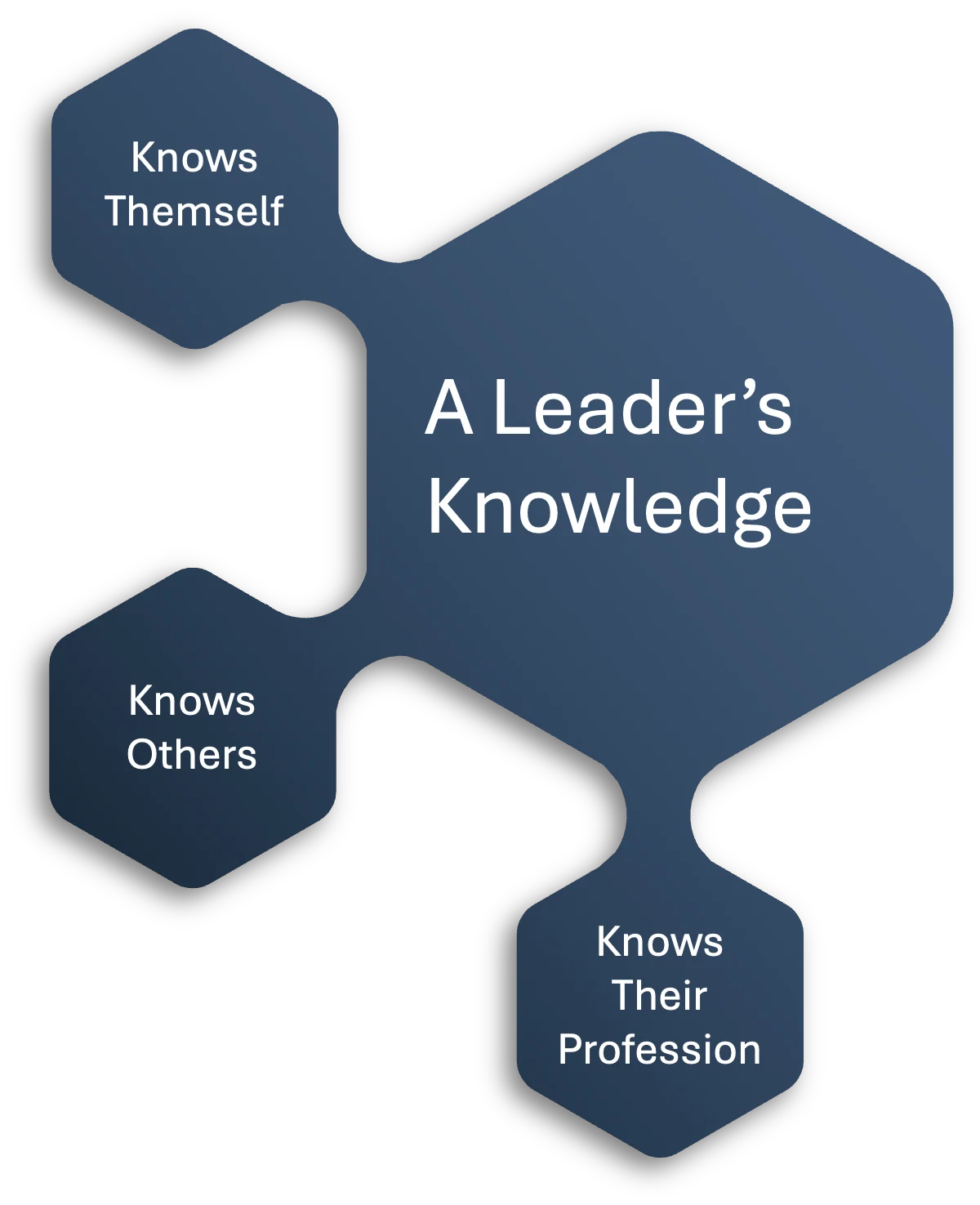
A Leader’s Knowledge
3 dimensions11 competencies103 observable behaviours
Knowledge equips leaders with the insight, awareness, and perspective required to exercise sound judgement. It enables leaders to interpret situations accurately, understand themselves and others, and apply professional expertise with discernment.
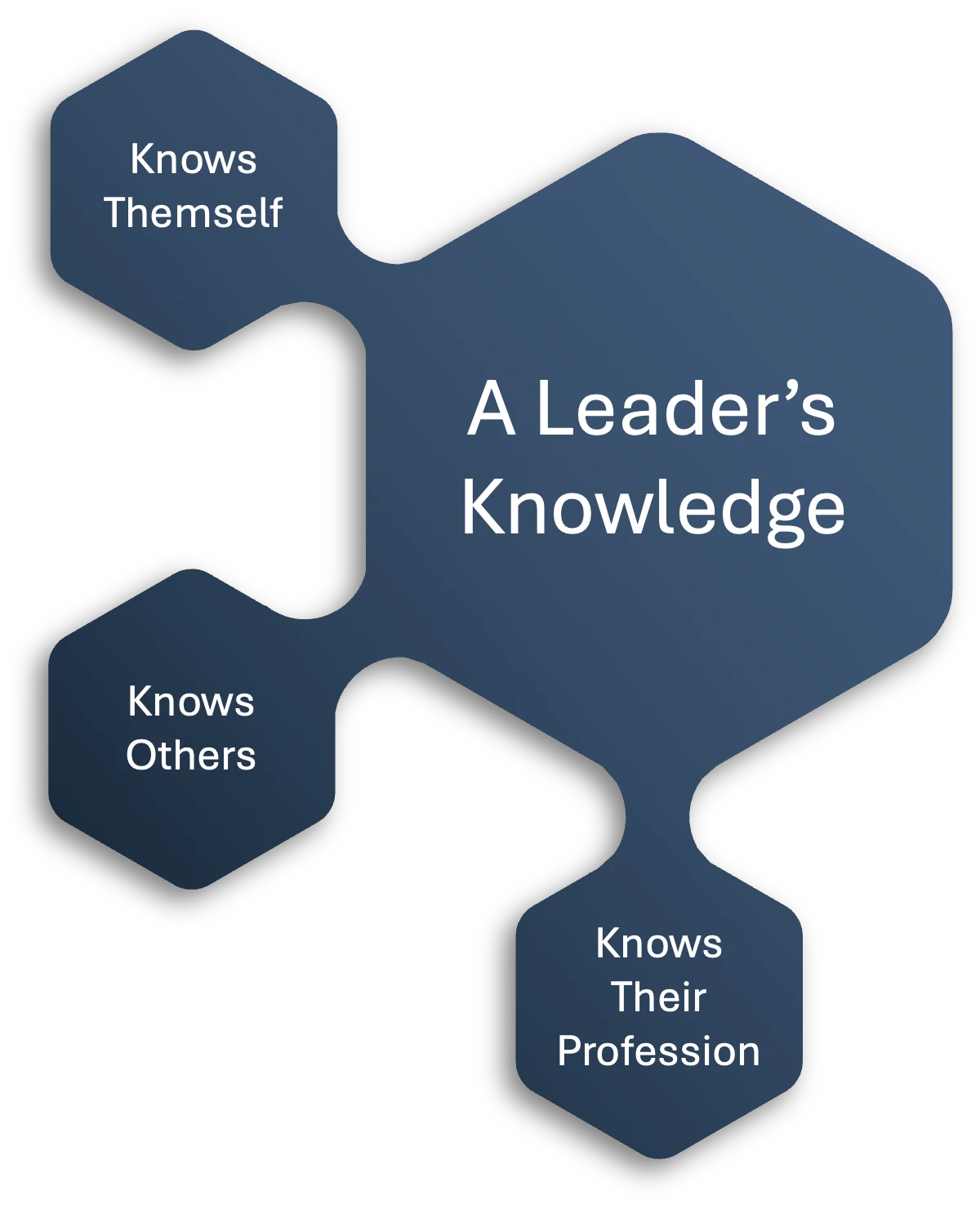
Leaders develop knowledge of self, others, and their profession as distinct but interdependent capabilities. Self-knowledge underpins self-regulation, resilience, and reflective thinking. Knowledge of others enables leaders to interpret human dynamics, relationships, and social context. Knowledge of the profession situates leadership within organisational systems and wider sectoral, national, and strategic environments. Together, this knowledge enables leaders to select and adapt behaviours appropriately, rather than applying them mechanically.
Knowledge is not static. It requires continuous learning, reflection, and adaptation, ensuring leaders remain credible, informed, and prepared to lead effectively across different contexts and levels of leadership application.
“Leadership and learning are indispensable to each other”
John F. Kennedy
Knows ThemselfLeaders know themselves
Leaders develop insight into themselves. They recognise their values, strengths, and limitations; regulate emotions under pressure; sustain performance through resilience and adaptability; and practise metacognition, thinking about their thinking to apply awareness, regulation, and sound reasoning.
Leaders demonstrate this through knowledge of:
Self-AwarenessLeaders demonstrate awareness of personal values, strengths, limitations, and leadership impact, enabling evidence-informed reflection, growth, and development.8 observable behaviours
- Identifies personal values, ambitions, motivators, and demotivators shaping behaviour and decisions
- Analyses strengths and limitations relative to role expectations, responsibilities, and future aspirations
- Evaluates stress patterns, triggers, destructive habits, and the impact of emotional responses on others
- Identifies own feelings, emotions, and biases influencing judgement and self-talk during interaction
- Seeks, integrates, and reflects on feedback to evaluate impact of own leadership approach on others
- Identifies competency and behavioural blind spots in leadership maturity to prioritise focused areas for self-development
- Reflects on past experiences and interactions, extracting lessons to inform and adjust future leadership practice
- Uses evaluative tools and multi-source feedback to build evidence of objective self-knowledge
Self-Management and ResilienceLeaders demonstrate adaptability and self-regulation of emotional impulses under pressure and stress, remaining composed, effective, and self-motivated to sustain balance, wellbeing, and resilience.8 observable behaviours
- Thinks before responding, regulating impulses to avoid emotionally reactive or destructive behaviour
- Anticipates stress escalation to triggers, regulating responses to minimise impact on self and others
- Reframes own mistakes, setbacks, and self-criticism into opportunities for learning, recovery, and growth
- Practises self-compassion to sustain confidence, self-efficacy, and a positive self-narrative
- Moves forward constructively and with determination amid uncertainty, ambiguity, or incomplete information
- Flexibly adapts thinking and behaviour to new, changing, or unexpected demands
- Sustains effort with optimism, humour, and perseverance when faced with challenge and adversity
- Seeks support from relationships and networks when demands exceed emotional capacity
Metacognition and Reflective ThinkingLeaders demonstrate awareness and cognitive control of thinking processes to test assumptions, refine judgement, and learn deliberately and intentionally from experience.10 observable behaviours
- Identifies cognitive processes and systematic biases shaping own reactions and reasoning quality
- Monitors how changing contexts influence own assumptions, problem-framing, and judgement
- Applies cognitive dexterity and control when under pressure to sustain attention and regulate focus
- Distinguishes material factors from inconsequential noise when analysing complex information
- Interrogates data and evidence to challenge assumptions and inform reasoning
- Critically reviews decisions and underlying logic to improve future judgement and cognitive maturity
- Calibrates reasoning by judging when to rely on intuition, stable assumptions, or analysis of data and evidence
- Evaluates others’ ideas critically, intentionally integrating challenge and diverse perspectives
- Synthesises information from multiple sources into relevant and coherent understanding and conclusions
- Redirects unproductive rumination toward constructive reasoning and analysis of next steps
Knows OthersLeaders know others
Leaders perceive people, teams, and relationships with clarity. They recognise social, cultural, and relational dynamics shaping cohesion and trust, adapting their communication and influence across contexts and challenges. By integrating these insights, they strengthen bonds, build inclusive teams, and foster belonging.
Leaders demonstrate this through knowledge of:
Social AwarenessLeaders apply insight into emotional, social, and situational cues to interpret team climate, improve participation, and strengthen empathy.9 observable behaviours
- Distinguishes others’ emotions from verbal and non-verbal cues, adjusting own response accordingly
- Interprets observed social cues and anticipates their effects on team dynamics and climate
- Detects misalignment between words, tone, and body language
- Notices silence, hesitation, or withdrawal as potential indicators of withheld views or discomfort
- Recognises when collective mood changes across the team, affecting interactions or performance
- Identifies informal influence patterns that shape decision-making and participation
- Identifies whose contributions are ignored or marginalised, detecting missing perspectives
- Infers underlying concerns from recurring emotional patterns and tensions
- Considers others’ perspectives before forming judgements in emotionally charged situations
Team DynamicsLeaders apply insight into individual and group interactions to strengthen cooperation, cohesion, and collective performance.10 observable behaviours
- Identifies individual strengths, weaknesses, and potential within the team
- Identifies individual motivators, demotivators, and biases affecting contribution and engagement
- Identifies how others respond to different stresses and pressures
- Assesses role demands against individual strengths to align fit and contribution
- Identifies patterns of constructive and unproductive interactions affecting team effectiveness
- Identifies team norms shaping challenge, accountability, and information sharing
- Analyses team member role interactions to identify gaps, overlaps, and collective blind spots
- Recognises individual workload or wellbeing factors constraining collective team performance
- Evaluates team climate, participation, and cohesion to diagnose performance barriers
- Identifies how differences in perspective shape participation, challenge, and decision quality
Relationship ManagementLeaders apply insight into sources of tension, conflict, and mistrust to build and sustain respectful, cohesive, and effective working relationships.9 observable behaviours
- Identifies areas of task, relationship, or process conflicts to manage tensions proactively
- Explores sources of tension affecting individual perceptions of fairness, equality, and mutual respect
- Identifies tensions between individual needs and collective team objectives
- Identifies early warning signs of trust erosion and explores effective remedies
- Identifies individual biases potentially affecting trust, respect, and relationship quality
- Listens attentively and without judgement to concerns raised during interpersonal exchanges
- Identifies and builds on areas of common ground to strengthen rapport and alignment
- Communicates with tact and diplomacy, promoting reciprocity and mutual respect
- Applies emotional and social awareness to strengthen empathy, rapport, and relational trust
Cultural AwarenessLeaders apply insight into societal, organisational, and team cultures, adapting communication and behaviour to sustain inclusion and performance.10 observable behaviours
- Identifies how societal, organisational, and team sub-cultures shape team dynamics and performance
- Analyses differences in inter-generational needs and expectations
- Identifies verbal and non-verbal differences and adapts communication approach accordingly
- Identifies how cultural norms influence emotional expression and interpretation
- Reviews assumptions and suspends judgement when working across cultural differences
- Adapts interaction norms to align with cultural expectations
- Seeks to deepen knowledge of relevant societal, organisational, and team sub-cultures
- Anticipates cultural tensions and evaluates their impact on inclusion, team dynamics, and performance
- Analyses how diverse cultural perspectives enhance problem-solving and organisational learning
- Demonstrates confidence, composure, and humility in culturally diverse interactions
Knows Their ProfessionLeaders know their profession
Leaders apply the professional, organisational, and contextual knowledge essential for effective leadership. They use specialist expertise, evaluate organisational systems, and interpret wider sectoral, stakeholder, and national influences to understand how these factors interact. This enables them to anticipate situational demands and adjust their leadership approach accordingly.
Leaders demonstrate this through knowledge of:
Professional and Technical ExpertiseLeaders evaluate professional knowledge, evidence, process, and technical standards to sustain credibility and exercise sound judgement.9 observable behaviours
- Demonstrates the necessary breadth and depth of technical expertise to underpin professional credibility
- Applies professional expertise with sound judgement in complex or high-accountability situations
- Maintains professional currency through continuous learning and awareness of emerging research, methods, and technologies
- Synthesises evidence and peer expertise to inform judgement and contribute to professional best practice
- Aligns professional decisions with organisational standards, goals, and ethical expectations
- Evaluates how technical, policy, and regulatory requirements must be integrated within delivery area planning
- Interprets performance and outcome data to inform evidence-based improvement
- Anticipates implications of policy and regulatory change on professional practice and delivery effectiveness
- Sustains professional credibility through consistent, competent, and ethical conduct
External Context and StakeholdersLeaders evaluate external conditions, systems, and stakeholders to align organisational objectives with local, community, and sectoral needs.10 observable behaviours
- Evaluates legal and regulatory governance requirements, including inspection and assurance findings
- Assesses local and regional policy shifts and priorities to align organisational outputs
- Assesses community and stakeholder needs and expectations, influencing organisational priorities
- Assesses service-user needs and sentiment to evaluate implications for service delivery
- Assesses competitor activity, sector leaders, and trends to identify threats and opportunities
- Assesses alignment and conformity to sector-specific regulatory and governance models
- Assesses environmental volatility, uncertainty, complexity, and ambiguity (VUCA) to inform adaptive leadership judgement and risk awareness
- Evaluates partnerships and operational dependencies shaping collaboration and service delivery
- Assesses resource, labour, and supply constraints affecting resilience and continuity
- Monitors environmental and sustainability obligations shaping organisational practice
Strategic and National PerspectiveLeaders evaluate national policy, security, and societal trends to inform strategic foresight, alignment, and responsible leadership judgement.10 observable behaviours
- Evaluates political and economic developments shaping long-term organisational priorities
- Scans geopolitical, demographic, and societal trends for strategic implications and opportunities
- Analyses power, authority, and influence across key stakeholders, institutions, and partnerships
- Evaluates interdepartmental and cross-sectoral networks shaping national systems of delivery
- Evaluates alignment with national priorities, regulatory expectations, and public-value commitments
- Applies strategic frameworks and concepts to evaluate organisational choices and trade-offs
- Integrates historical lessons and comparative cases into strategic judgement
- Evaluates emerging technologies, data, and innovation for strategic disruption, opportunity, and risk
- Assesses strategic communications approach, narratives, and sources of reputational risk
- Stress-tests the resilience of strategy and plans against scenarios of volatility, uncertainty, complexity, and ambiguity
Organisational Systems and ProcessesLeaders evaluate organisational structures, processes, systems, and interdependence to align effort and enhance delivery coherence.10 observable behaviours
- Evaluates organisational structures and interdependencies that enhance or constrain delivery
- Analyses formal and informal decision-making processes shaping organisational outcomes
- Evaluates governance, assurance, and compliance systems that sustain accountability
- Evaluates organisational risk frameworks, enhancing capacity to anticipate and mitigate disruption
- Evaluates how resource allocation processes influence sustainability and operational efficiency
- Interprets performance indicators, metrics, and measures of effectiveness to identify systemic improvement opportunities
- Critiques internal processes to identify inefficiencies and operating constraints
- Evaluates the level of stakeholder influence and support affecting the organisational ecosystem
- Assesses how policy and procedural requirements shape operating effectiveness
- Evaluates learning and feedback loops embedded within systems to support continuous improvement
Domain 3 of 3 · What leaders do
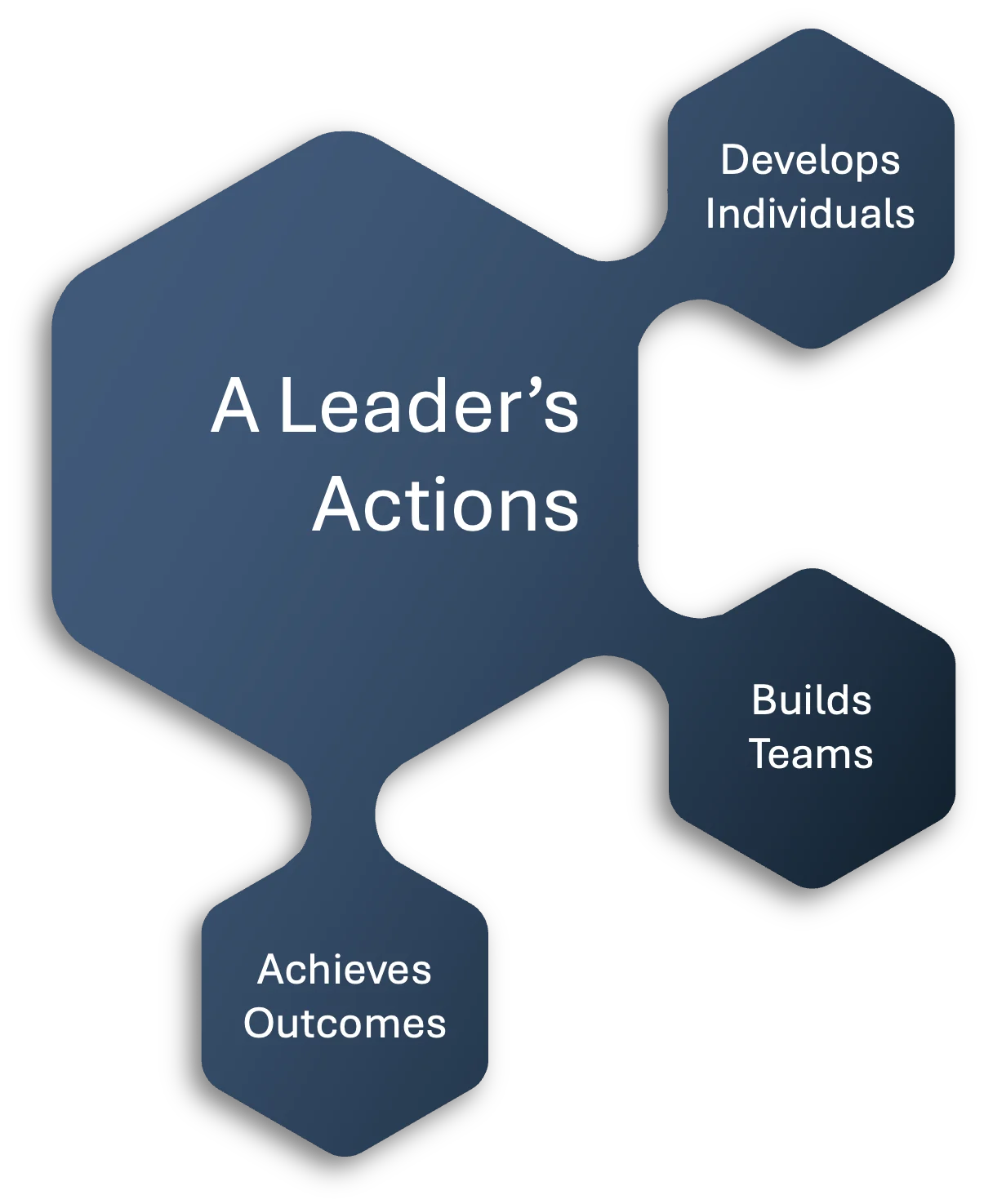
A Leader’s Actions
3 dimensions11 competencies125 observable behaviours
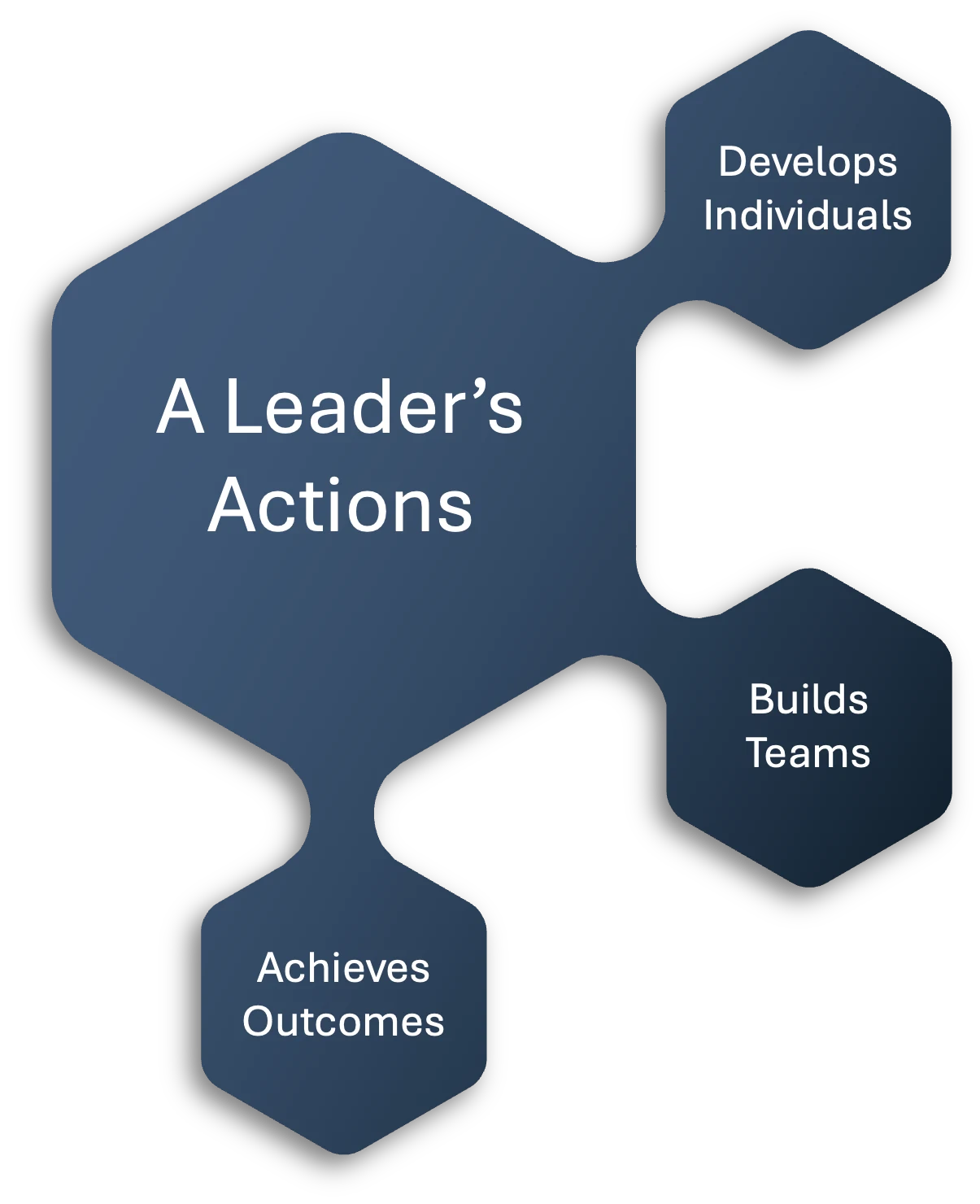
Action is where leadership becomes visible. It is the application of character and knowledge in practice, the translation of values and insight into purposeful outcomes. Leaders develop themselves and others, build cohesive teams, and achieve their outcomes, often in uncertain and ambiguous environments.
This model of Action-Centred Leadership requires establishing a purpose, setting parameters, empowering others, and adapting approaches to sustain performance amid complexity and change.
By focusing on people, teams, and outcomes together, leaders balance the competing demands of leadership, ensuring intent is realised, trust is strengthened, and collective success is achieved.
† Adair, J. (1979), Action-Centred Leadership.
“Leadership is action, not position”
Donald H. McGannon
Develops IndividualsLeaders develop individuals
Leaders build other leaders. They enable growth as a continual responsibility, sustaining their own capability, resilience, health, and wellbeing while developing those they lead. Through feedback, coaching, balanced support, and challenge, they build confidence, skill, and adaptability so individuals thrive, learn, and contribute at their full potential. In doing so, they model curiosity and humility, inspiring commitment to lifelong learning and shared improvement.
Leaders demonstrate this through the competencies of:
Developing ThemselvesLeaders enable personal growth through purposeful and conscientious learning, reflection, and sustained commitment to professional improvement.11 observable behaviours
- Sets specific development goals linked to personal growth and leadership impact
- Diagnoses priority knowledge and skill gaps impacting leadership effectiveness
- Creates purposeful development plans and routines to sustain personal learning
- Accepts ownership of development through self-motivation and accountability for continuous growth
- Applies new learning deliberately to improve day-to-day leadership practice
- Seeks targeted coaching, mentoring, and peer support to guide ongoing development
- Seeks multi-source feedback on leadership impact, integrating insights from others
- Reflects critically on conduct, feedback, and experience to inform areas for improvement
- Transfers learning to different contexts, adapting behaviour after success, failure, or change
- Maintains physical, mental, and emotional routines for sustained health, wellbeing, and performance
- Balances ambition and aspirations with reality to sustain focus, energy, and performance over time
Providing Support and ChallengeLeaders enable individual performance and development through balanced empathy, feedback, coaching, and constructive accountability.12 observable behaviours
- Guides translation of needs and aspirations into actionable goals, plans, and learning priorities
- Provides reassurance and steadiness to others during uncertainty, sustaining confidence and focus
- Provides timely and constructive feedback, reinforcing strengths and promoting effective learning and growth
- Sets stretch objectives linking personal growth to collective goals
- Facilitates reflection on past experiences to enhance learning and improvement
- Collaboratively explores ways to offer support to others’ growth and development
- Guides recovery and learning after setbacks or failure to rebuild confidence and adaptive performance
- Guides problem-solving to overcome obstacles and sustain performance under pressure
- Promotes physical, mental, and emotional wellbeing to sustain energy and resilience
- Recognises others’ efforts, contributions, and impact, strengthening confidence, motivation, and self-efficacy
- Continually reviews developmental progress to adjust the balance of guidance, support, and challenge
- Balances time between task delivery with visibility and presence in support of others
Inspiring and Enabling OthersLeaders enable others to realise their potential by motivating, mentoring, and empowering them to perform, learn, and grow.11 observable behaviours
- Expresses belief in others’ abilities and potential through sustained trust, time investment, and encouragement
- Provides progressive responsibility and exposure, developing confidence and decision-making capability
- Provides mentoring and guidance that builds autonomy, independent confidence, and professional judgement
- Creates meaningful opportunities for others to learn, expand skills, and professionally progress
- Aligns emerging talent with opportunities to maximise growth and contribution
- Identifies emerging strengths and development needs to inform long-term growth planning
- Develops others’ self-reflective habits to sustain independent and continuous learning
- Addresses under-performance through constructive dialogue and structured development planning
- Positively affirms growth and progress, clarifying next-steps and opportunities to build self-belief
- Ensures equitable access to mentoring, guidance, and development opportunities
- Encourages strategic and bigger-picture thinking to broaden understanding, perspectives, and ambitions
Builds TeamsLeaders build teams
Leaders inspire shared purpose and commitment to build cohesive, inclusive, high-performing teams. They communicate clearly, foster psychological safety, and adapt team structures, rhythms, and interactions to sustain performance. Leadership within teams is a shared endeavour characterised by high intellectual friction and low social friction: leaders and followers co-create purpose, solve complex problems, and deliver results through respectful debate, strengthening collective identity, and unlocking the potential of diverse contributions.
Leaders demonstrate this through the competencies of:
Creating Psychological SafetyLeaders foster openness, trust, and belonging so people feel included and safe to learn, contribute, and challenge constructively.12 observable behaviours
- Establishes clear and respectful norms, preventing belittlement, ridicule, and exclusion
- Invites informed and constructive challenge of ideas and assumptions, reducing fear of negative consequences
- Responds with composure and tolerance when mistakes or unwelcome information are raised
- Invites candid discussion and shared learning once assumptions, freedoms, and constraints are understood
- Examines ideas critically and respectfully, keeping debate focused on issues rather than individuals
- Provides fair, reasoned, and courteous explanations when disagreeing or declining suggestions
- Encourages inquisitive questioning to identify gaps in knowledge and build shared understanding
- Facilitates curiosity-led dialogue that supports creativity, critical thinking, and collaborative problem-solving
- Creates a safe-to-fail environment that enables and celebrates purposeful experimentation, initiative, and learning
- Actively seeks underrepresented perspectives, incorporating them into constructive discussion
- Ensures decisions reflect reasoned contributions from collective participation before moving forward
- Publicly acknowledges constructive challenge as a commitment to shared problem-solving
Cultivating TeamshipLeaders foster shared commitment, cohesion, and trust between leaders and followers to build collective accountability and mutual support.12 observable behaviours
- Affirms leadership as a shared endeavour with interdependent roles and responsibilities
- Clarifies decision authority and accountability to set role expectations and reduce ambiguity
- Enables follower agency, autonomy, and influence in addressing shared leadership challenges
- Invites constructive dissent, feedback and independent, critical thought
- Willingly defers to others when their expertise best serves team success
- Balances authority with openness, encouraging participation and challenge before decisions are taken
- Builds consensus, commitment, and shared ownership around collectively agreed decisions
- Recognises and celebrates cooperation and co-creation that contributes to collective success
- Creates opportunities for others to lead within their areas of expertise, strengthening shared ownership
- Encourages peer-to-peer accountability for upholding shared values and standards
- Facilitates collective reflection to strengthen leader and follower effectiveness over time
- Secures commitment once decisions are made, discerning destructive dissent from constructive criticism in debate
Communicating EffectivelyLeaders foster clarity and shared understanding by adjusting communication approaches to meet audience needs and expectations.11 observable behaviours
- Listens actively and attentively to understand perspectives before responding or deciding
- Uses effective questioning to confirm and deepen understanding
- Confirms communication intent and audience needs before delivering key messages
- Uses clear, concise, and unambiguous language to convey key messages
- Adapts language, tone, and style to suit audience, context, and intent
- Provides relevant context to aid understanding and alignment with organisational objectives
- Explains decisions and rationale honestly and transparently to enhance collective advocacy
- Invites questions and feedback to confirm and reinforce shared understanding
- Integrates verbal and non-verbal cues to reinforce meaning and authenticity
- Chooses delivery method and timing to match audience, message complexity, and sensitivity
- Communicates with positivity, passion, and optimism to inspire collective support
Building and Sustaining High PerformanceLeaders foster a climate of clear expectations, effort alignment, disciplined standards, continuous improvement, and collective identity.12 observable behaviours
- Clarifies roles, responsibilities, and expectations aligned to knowledge, skills, experience, and specialisation
- Collectively defines and agrees on shared values and standards of behaviour to promote collective accountability
- Establishes a healthy, competitive team spirit to stretch capability and sustain high performance
- Builds a sense of collective identity, belonging and community, grounded in mutual respect and shared values
- Builds cohesion and shared belief through collaborative problem-solving and celebrating success
- Agrees consistent routines with the team that sustain performance, focus, and momentum, reviewing them together as needs change
- Facilitates high intellectual friction through respectful challenge and evidence-informed debate
- Reduces social friction by focusing on the problem, not people
- Draws on collective insight to identify opportunities to enhance effectiveness
- Encourages bold but disciplined risk-taking to drive improvement and exploit opportunities
- Adapts leadership approach dynamically to sustain performance when facing challenge or change
- Energises teams under pressure by reinforcing shared purpose, resilience, and mutual support
Achieves OutcomesLeaders achieve outcomes
Leaders translate intent into purposeful, coordinated action, delivering meaningful and enduring results. They think strategically, defining clear ends, selecting suitable ways, and aligning means to connect vision with execution. Acting with judgement, pace, and moral responsibility, they sustain trust and momentum under pressure. By empowering others to apply insight and initiative, they foster shared ownership of success. Through reflection and adaptation, they refine performance, strengthen resilience, and ensure that achievement is responsible, sustainable, and true to its purpose.
Leaders demonstrate this through the competencies of:
Defining and Aligning PurposeLeaders deliver coherence of effort by framing intent, priorities, and freedom to act around shared organisational purpose.10 observable behaviours
- Articulates a compelling vision from which a shared purpose can be established
- Communicates intent, objectives, and priorities to clarify individual and collective focus
- Integrates ends, ways, and means to maintain strategic coherence and alignment of effort
- Translates intent into achievable objectives and measurable outcomes to sustain motivation and momentum
- Engages others in co-creating goals, objectives, and outcomes, strengthening shared ownership and accountability
- Regularly reinforces the vision by connecting everyday efforts and actions to the shared purpose
- Reconciles routine choices, decisions and actions with affirmative progress toward the collective vision
- Frames barriers and challenges accurately, discerning their causes and effects on objectives and outcomes
- Balances ambition with task reality when prioritising under constraints or in uncertainty
- Reviews and adjusts priorities as context shifts to keep purpose relevant and achievable
Empowering OthersLeaders enable individual and collective autonomy by agreeing parameters, sharing decision rights, and encouraging initiative aligned to the shared intent.11 observable behaviours
- Clarifies delegated freedoms, operating constraints, decision rights, and risk tolerance
- Confirms understanding of intent, tasks, and outcomes, providing opportunities for clarifying questions
- Delegates meaningful responsibility matched to individual competence and situational context
- Determines which decisions can be delegated, shared, or retained, explaining rationale clearly
- Entrusts delegated responsibilities with clear ownership and accountability for outcomes
- Provides essential information and context to enable effective independent decision-making
- Demonstrates faith and confidence in others’ judgement through proportionate oversight and support
- Intervenes only when deviation threatens shared purpose, standards, or organisational integrity
- Promotes bold, innovative, and resourceful risk-taking within agreed freedoms and boundaries
- Credits sound judgement exercised within delegated authority, reinforcing confidence and trust
- Recalibrates delegated authority as competence, confidence, and context evolve
Making Effective DecisionsLeaders deliver effective outcomes by integrating evidence, judgement, creativity, and risk into timely and accountable decision-making.12 observable behaviours
- Frames problems collaboratively, integrating diverse sources of information, experience, and feedback
- Distils complexity and ambiguity into clear, intent-aligned options for achieving outcomes
- Identifies areas of uncertainty, assumptions, and information gaps that could undermine problem analysis
- Balances data and evidence with intuition and experience when forming judgements and decisions
- Evaluates the feasibility, proportionality, risk, and resource implications of options
- Generates and evaluates alternative courses of action, weighing trade-offs and consequences with outcomes
- Independently tests reasoning and assumptions to reduce bias and groupthink
- Applies creative and analytical thinking to design adaptive and innovative solutions
- Makes timely, reasoned, and proportionate decisions, avoiding emotional or ego-driven reactions
- Monitors evolving situations, adapting decisions as conditions, information, and risk change
- Reviews progress and emerging outcomes to confirm decision validity and inform subsequent actions
- Integrates feedback from diverse sources to improve future judgement and decisions
Cultivating Collaboration and PartnershipsLeaders deliver success through cooperation, mutual trust, aligned priorities, and shared values across organisational and sectoral boundaries.11 observable behaviours
- Aligns cross-organisational purpose, priorities, and values to achieve shared outcomes
- Anticipates risks and system interdependencies to align joint stakeholder planning and problem solving
- Co-designs governance, roles, and decision rights to enable coordinated delivery
- Creates cross-boundary psychological safety so partners raise concerns early
- Builds trusted, cross-organisational networks through honesty, reciprocity, and consistency
- Ensures fairness, equity, and transparency in shared decisions and allocation of resources
- Shares timely, accurate, and relevant information to enable collective understanding and alignment
- Resolves partnership conflicts constructively while safeguarding shared principles
- Acknowledges partner contributions and shares credit for collective achievements
- Leverages cross-organisational diversity to generate innovation and shared learning
- Reviews partnership outcomes and adapts agreements as conditions evolve
Sector translations
Make the Framework your own
The NLF is written to be translated. We encourage organisations and sectors to publish their own versions of it, in their own language, values and context.
- Your language and values
- Your sector’s pressures and standards
- The NLF’s concepts intact
A sector translation carries every NLF domain, dimension, competency and observable behaviour into the words, roles and pressures of a particular sector or organisation: a bank’s risk culture, a school’s safeguarding duties, a hospital’s clinical governance. The structure can change, levels can be renamed and behaviours rewritten, provided the concepts behind them remain intact and observable.
A well-made translation is mapped to the NLF dimension by dimension and competency by competency, so it meets the framework requirement of Award Criterion 1 (Leadership Policy), up to Gold, while reading as the organisation’s own. If your organisation does not yet have a leadership framework, you can start from one of our ready-made sector examples, adapt it and run with it now.
Get your free copy of the Framework
Free to download. Your copy is ready straight away, and we never share or sell your details.